Most people check the outdoor air quality app when wildfire smoke rolls in. Almost nobody thinks about what they're breathing inside their home the rest of the time — and that's a problem, because indoor air is often worse.
This post contains affiliate links. We may earn a small commission at no extra cost to you.Volatile organic compounds from furniture and paint, CO₂ from people and pets, humidity extremes that breed mold and dust mites, particulates from cooking: all of this accumulates in sealed, insulated homes without any natural signal that anything is wrong. You just feel groggy, or your sleep is bad, or your allergies flare — and you blame the season.
Smart air quality monitors change that. And in 2026, the sensors are good enough, and cheap enough, that there's no reason to fly blind.
TL;DR
- Indoor air quality (CO₂, PM2.5, VOCs, humidity) significantly affects sleep and cognitive performance
- The best all-in-one monitors are the Airthings View Plus, Govee Air Quality Monitor, and Awair Element
- Connect your monitor to a smart purifier or ventilation fan to automate the response, not just the alert
- CO₂ above 1000 ppm is where you'll notice cognitive effects — most closed rooms hit this by mid-morning
- Renters can do this without any drilling or landlord permission
---
Why Indoor Air Quality Actually Matters
The EPA has noted for years that indoor air can be two to five times more polluted than outdoor air — sometimes significantly worse. But the effects have gotten clearer with recent research.
CO₂ is the most instructive example. In a sealed office or bedroom with a few people in it, CO₂ levels routinely climb above 1,500 ppm by late morning. Research from the Harvard T.H. Chan School of Public Health found measurable cognitive decline — slower response times, worse decision-making — at CO₂ concentrations around 1,000 ppm. That's a level most people regularly hit without knowing it.
PM2.5 (fine particulate matter) matters for respiratory health and has been linked to cardiovascular effects at sustained elevated levels. Cooking without ventilation, candles, incense, and even 3D printing can spike PM2.5 indoors to levels you'd evacuate a city block for outdoors.
VOCs (volatile organic compounds) off-gas from furniture, flooring, cleaning products, and paint. New furniture in a closed room can hit VOC levels that cause headaches and eye irritation within hours.
None of this means your home is a hazard zone. It means the data is worth having.
---
What Sensors You Actually Need
Not every monitor measures everything equally well. Here's what matters and what's worth paying for:
CO₂
This is the most actionable metric. High CO₂ almost always means insufficient fresh air, and the fix (open a window, run a fan, improve ventilation) is immediate and free. Look for electrochemical (NDIR) CO₂ sensors — they're accurate and stable. Cheap monitors often use estimated CO₂ (eCO₂) derived from VOC sensors, which is much less reliable.
PM2.5
Fine particulate matter. Essential if you have concerns about air purifier effectiveness, cooking smoke, or outdoor pollution events. Laser particle counters are the standard at this price range; they're accurate enough to be actionable.
VOCs / TVOC
Total volatile organic compounds. Useful as a relative indicator — spikes when you use cleaning products, open a new piece of furniture, or have gas appliances. The absolute numbers are harder to interpret than CO₂ or PM2.5, but trends matter.
Humidity and Temperature
Both affect comfort, sleep, and health. 40-60% relative humidity is the sweet spot — below that you get dry skin and increased viral transmission, above it you risk mold and dust mites. Smart thermostats handle temperature, but humidity often goes unmonitored.
Radon (Optional)
Radon is a long-term health risk, particularly in basements and ground-floor units in certain geologies. If you're in a high-radon area, it's worth monitoring. The Airthings View Plus includes radon; most other monitors don't.
---
The Best Monitors in 2026
Airthings View Plus (~$299)
The most comprehensive option. It covers CO₂ (NDIR), PM2.5, VOCs, humidity, temperature, radon, and light. The app is well-designed and shows historical trends that make the data actually useful. It connects to Apple Home, Google Home, and Alexa, and has a wave-based radon sensor that works without lab analysis.
Best for: homeowners or renters who want one device that covers everything, including radon.
Awair Element (~$149)
CO₂ (NDIR), PM2.5, VOCs, humidity, temperature. No radon, but excellent sensor quality for the price and a strong app with actionable recommendations. It integrates with IFTTT, which means you can connect it to almost anything — smart plugs, fans, purifiers, Alexa routines.
Best for: apartment dwellers who want solid data without the radon sensor and a tight integration story.
Govee Air Quality Monitor (~$69)
PM2.5, VOCs (estimated CO₂), humidity, temperature. The CO₂ reading is eCO₂ (estimated, not direct), which limits its usefulness for ventilation decisions. But for PM2.5 and humidity tracking, it punches well above its price. Works with the Govee app and Alexa.
Best for: a first monitor or a secondary room sensor where CO₂ accuracy isn't the priority.
Placement tip: Don't put your monitor directly next to a window, AC vent, or cooking area. Central room placement at seated breathing height (about 3-4 feet off the ground) gives the most representative readings.---
Automating the Response (Not Just the Alert)
Knowing your CO₂ is at 1,400 ppm is only useful if you do something about it. Smart home automation lets you act on air quality data automatically, which is where this goes from interesting gadget to genuinely useful system.
Purifier + Air Quality Trigger
If you have a smart air purifier (or connect a standard purifier to a smart plug), you can set it to run automatically when PM2.5 or VOC levels spike.
Using the Awair Element + Alexa:
- Create an Alexa Routine triggered by the Awair's PM2.5 reading crossing a threshold
- Set action: turn on smart plug connected to your air purifier
- Add a second routine to turn it off when PM2.5 returns to baseline
With Google Home and compatible devices (like the Govee monitor or Airthings), you can use the built-in automation tools in a similar way.
Ventilation Fan Trigger
For high CO₂, the best fix is fresh air — which means a window, an ERV (energy recovery ventilator), or a bathroom fan running to create slight negative pressure. If your bathroom fan is on a smart switch, you can automate it to run when CO₂ climbs above 1,000 ppm.
This is particularly useful in home offices and bedrooms. A CO₂-triggered ventilation fan running for 15 minutes every time levels spike above 1,000 ppm keeps your workspace below the threshold where cognitive effects start showing up.
Morning Air Quality Briefing
Add your air quality monitor to your morning voice routine (covered in detail in our voice routines guide). A brief summary of overnight conditions — "CO₂ is at 820 ppm, humidity is 52%, air is clean" — takes five seconds and gives you useful context before you decide whether to open windows or run the purifier.
---
Renters: No Drilling Required
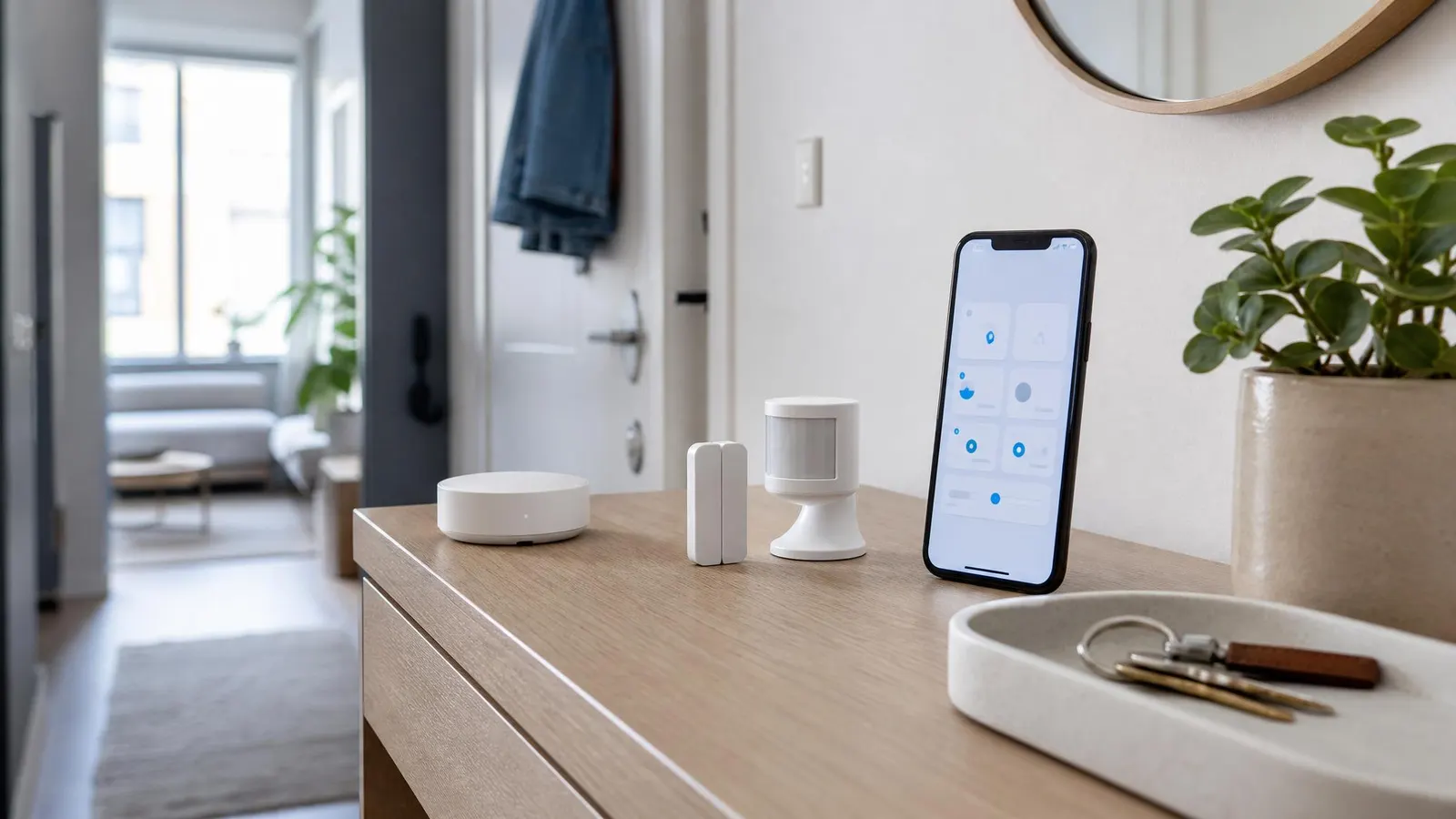
Every monitor listed above is plug-and-play — power via USB or a wall outlet, no installation. You can monitor your whole apartment with two or three sensors placed on shelves or counters. No landlord conversation needed.
If you're in a place with windows but poor cross-ventilation, a smart window fan triggered by high CO₂ is the most effective ventilation upgrade you can make without modifying anything structural. Combine it with an air quality monitor and a smart plug, and you have an automated ventilation system for under $150.
---
Reading the Data: What Numbers to Watch
Once your monitor is up and running, here are the thresholds worth acting on:
| Metric | Good | Okay | Act Now |
|---|---|---|---|
| CO₂ | < 800 ppm | 800–1,000 ppm | > 1,000 ppm |
| PM2.5 | < 12 µg/m³ | 12–35 µg/m³ | > 35 µg/m³ |
| Humidity | 40–60% | 35–40% or 60–65% | < 35% or > 65% |
| VOC (TVOC) | < 0.3 mg/m³ | 0.3–1.0 mg/m³ | > 1.0 mg/m³ |
CO₂ over 1,000 ppm is the most common actionable alert in most homes. Crack a window, run a fan for 20 minutes, and watch it drop. Once you see it happen in real time, you'll understand intuitively why your post-lunch brain fog at your home office desk was a ventilation problem, not a you problem.
---
The Bottom Line
Smart air quality monitoring is one of the few smart home upgrades with a direct, measurable impact on how you feel day to day. The data is legible, the actions are simple (ventilate or purify), and the automation potential is real — especially for remote workers who spend most of the day in the same room.
Start with one monitor in the room you spend the most time in. Give it a week. The patterns in the data will tell you exactly what to fix next.
Further reading:- EPA: Introduction to Indoor Air Quality — authoritative baseline on pollutant sources and health effects
- ASHRAE Ventilation Standards — the industry standard on residential ventilation rates
- Smart Plugs for Renters: Our 2026 Picks